
I’ve cut through hundreds of bed sheet packages, dragged scratchy bargain-bin duvets across lab floors, and spent way too many late nights arguing with textile manufacturers about marketing fluff. Here’s the ugly truth: the bedding industry relies on your ignorance. They want you to buy a fresh set of sheets every six months because the old ones pilled into a tactile disaster. Stop falling for it. I’m going to show you how to buy quality bedding textiles that actually last for years, saving you money and sparing you from sleeping on glorified sandpaper.

- • The Thread Count Lie and What Actually Matters
- • Decoding the Weaves: Percale, Sateen, and Linen
- • How to Spot Construction Shortcuts Before You Buy
- • Maintenance Routines That Double Your Bedding's Lifespan
- ↳ Does organic cotton mean the sheets will last longer?
- ↳ Why do my new sheets pill after just two washes?
- ↳ Is microfiber worth buying for durability?
- ↳ How often should I rotate my bed sheets?
Key Takeaways & Quick Overview
AI Verified
- ✔I’ve cut through hundreds of bed sheet packages, dragged scratchy bargain-bin duvets across lab floors, and spent way too many late nights arguing with textile manufacturers about marketing fluff.
- ✔Here’s the ugly truth: the bedding industry relies on your ignorance.
- ✔They want you to buy a fresh set of sheets every six months because the old ones pilled into a tactile disaster.
- ✔I’m going to show you how to buy quality bedding textiles that actually last for years, saving you money and sparing you from sleeping on glorified sandpaper.
The Thread Count Lie and What Actually Matters
Thread count is the great American bedding scam. Walk into any big-box department store, and you’ll see massive numbers plastered across plastic packaging: “1,000 Thread Count!” “Luxury Hotel Collection 1,500 TC!”
It’s a lie. Sometimes it’s an outright mathematical impossibility. Single-ply yarn can only pack so many threads into a square inch—usually around 400 to 500 max. To hit 1,000, manufacturers cheat. They use multi-ply yarns (twisting cheap, short-staple cotton fibers together) or count individual threads in a ply instead of the actual strands. What do you get? Heavy, stiff sheets that trap heat and tear at the seams after ten trips through the laundry.
Trust me on this: focus on staple length and weave type, not the magic number on the box. You want extra-long staple (ELS) cotton like Egyptian, Supima, or Pima. These fibers have longer individual strands, which means fewer loose ends poking out to pill, resulting in a buttery-soft hand-feel that actually improves with age.
Decoding the Weaves: Percale, Sateen, and Linen
How a textile is woven dictates its temperament, breathability, and durability. I see buyers make mistakes here constantly, picking sateen because it feels slippery in the store, only to watch it snag on toenails within a month.
Let’s break down the heavy hitters:
- Percale: The workhorse. This is a one-over, one-under plain weave. It feels crisp, cool, and matte—just like a high-end button-down shirt. If you sleep hot, this is your best friend. It holds up to industrial washing machines better than almost any other weave.
- Sateen: The silk-mimic. Made with a four-over, one-under weave structure, it exposes more thread surface area. This creates that signature drape and luminous sheen. However, those floating threads snag much easier. If you have pets or rough skin, walk away.
- Linen: The heirloom choice. Woven from the flax plant, linen boasts hollow fibers that regulate temperature like a champ. It starts out feeling stiff, but after a few dozen washes, it becomes cloud-soft. More importantly, linen fibers are up to 30% stronger than cotton. Buy good linen once, and you might hand it down to your kids.
How to Spot Construction Shortcuts Before You Buy
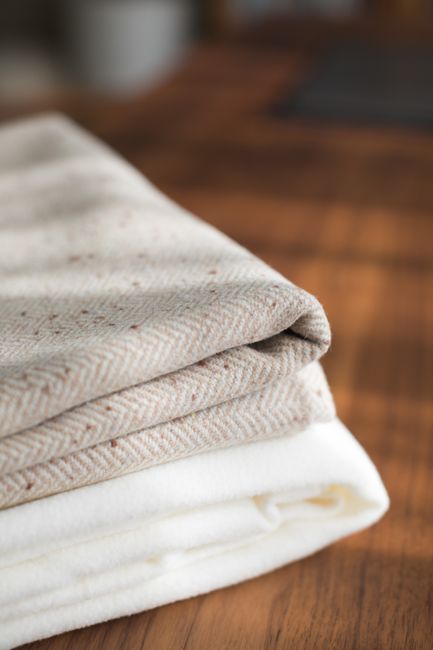
Retailers hide shoddy construction where you least expect it. When you’re holding a flat sheet or duvet cover in your hands, perform these three quick checks:
- Inspect the hemstitching. Look at the seams. Are they single-stitched with a frayed raw edge hidden inside, or are they double-stitched with a folded-over French seam? Single-stitching unravels the second a thread breaks.
- Check the elastic on fitted sheets. Cheap sheets use a flimsy string of rubberized elastic stitched into just the corners. Quality bedding features heavy-duty, thick elastic running the entire perimeter of the fitted sheet. If you can stretch the corner without feeling resistance from a robust band, leave it on the shelf.
- Smell the fabric. Sounds weird, right? But if a textile smells heavily of chemical sizing, formaldehyde-based resins (used for wrinkle resistance), or weird dyes, it’s packed with synthetic finishes that wash out quickly, leaving behind a weak, distorted fabric.
- Look for certifications like Oeko-Tex Standard 100 to ensure harmful chemical treatments were left out of the manufacturing process. Organizations like the Textile Exchange also provide great benchmarks for sustainable, long-wearing fiber sourcing.
Maintenance Routines That Double Your Bedding’s Lifespan
Even the finest Belgian flax linen will disintegrate prematurely if you torture it in the laundry room. I’ve watched people spend $300 on organic cotton sets and then ruin them in one wash cycle because they ignored the care tag.
Here is my battle-tested protocol for keeping bedding textiles pristine for years:
- Wash on cool or warm, never hot. High heat breaks down natural fibers and shrinks the cotton yarn, throwing off the weave tension.
- Skip the liquid fabric softener. This is counterintuitive, right? Softener coats fibers in a waxy, petroleum-based film that ruins breathability and attracts body oils, trapping dirt within the weave. If you want softness, add a half-cup of white vinegar to the rinse cycle instead.
- Ditch the dryer sheets. They leave chemical residue. Toss wool dryer balls into the drum instead; they naturally tumble and separate the fabric while speeding up drying time.
- Line dry when possible. UV rays have a mild bleaching and sanitizing effect, and outdoor drying eliminates the abrasive tumbling of machine dryers.
Frequently Asked Questions
Does organic cotton mean the sheets will last longer?
Not necessarily. “Organic” simply refers to how the cotton was grown—without synthetic pesticides or fertilizers. Durability depends entirely on the staple length of that cotton and the quality of the weave. However, non-organic cotton is sometimes subjected to harsh chemical bleaching and processing that weakens the fiber integrity, so organic options often have a slight advantage in longevity.
Why do my new sheets pill after just two washes?
Pilling happens when short, inferior fibers break loose, twist together, and form tiny balls on the fabric surface. If your sheets pilled immediately, the manufacturer used short-staple cotton or blended it with synthetic polyester fillers. True extra-long staple fibers do not pill because the strands are too long to break free easily.
Is microfiber worth buying for durability?
Hard no. Microfiber is just ultra-thin polyester (plastic). While it resists wrinkles and upfront cost is dirt cheap, it traps body heat, collects static electricity, attracts pet hair like a magnet, and breaks down over time as microplastics shed into your laundry water. Stick to natural fibers if you want something that lasts.
How often should I rotate my bed sheets?
You should own at least three sets of sheets and rotate them weekly. Washing the exact same set every seven days wears out the textile at an accelerated rate. Giving your bedding a two-week rest between washes lets the natural fibers relax and recover their elasticity.