
How to Choose Long-lasting Kitchen Knife Sets on a Moderate Budget Guide
I’ve lost count of how many kitchen knife sets I’ve sliced, diced, and stress-tested over the past fifteen years of cooking and writing about culinary gear. Here’s the ugly truth the industry doesn’t want you to know: most twenty-piece knife blocks sitting on department store shelves are overpriced junk. You’re paying for flimsy steak knives you’ll never use and a glossy wooden block that breeds bacteria. If you want a setup that survives daily meal prep for a decade or more without emptying your bank account, you need to ignore the flashy marketing and focus on pure metallurgy, construction, and ergonomics. Let’s cut through the noise and figure out how to build a killer kit on a realistic budget.
- • The Anatomy of a Scam: Why Most Knife Blocks Fail
- • Forged vs. Stamped: Debunking the Steel Myth
- • The Essential Trio: What Your "Set" Should Actually Contain
- • Handle Ergonomics and Balance: The Feel Test
- ↳ Should I put my new kitchen knife set in the dishwasher?
- ↳ Are Japanese or German knives better for a moderate budget?
- ↳ How often do I need to sharpen a budget knife?
- ↳ Is it better to buy knives individually or as a set?
Key Takeaways & Quick Overview
AI Verified
- ✔How to choose long-lasting kitchen knife sets on a moderate budget guide i’ve lost count of how many kitchen knife sets i’ve sliced, diced, and stress-tested over the past fifteen years of cooking and writing about culinary gear.
- ✔Here’s the ugly truth the industry doesn’t want you to know: most twenty-piece knife blocks sitting on department store shelves are overpriced junk.
- ✔You’re paying for flimsy steak knives you’ll never use and a glossy wooden block that breeds bacteria.
- ✔If you want a setup that survives daily meal prep for a decade or more without emptying your bank account, you need to ignore the flashy marketing and focus on pure metallurgy, construction, and ergonomics.
The Anatomy of a Scam: Why Most Knife Blocks Fail
Walk into any home goods store, and you’ll see massive knife blocks boasting “18 pieces” for under a hundred bucks. Run away. Fast. When manufacturers cram that many knives into a low price point, they are cutting massive corners.
First, look at the steel. Cheap knives use soft stainless steel that bends easily and loses its edge after chopping half an onion. You spend more time dragging the blade across a pull-through sharpener than actually cooking. Second, look at the construction. Many budget blocks feature “partial tangs,” meaning the metal of the blade barely extends an inch into the handle. One aggressive squash-squishing session, and the blade snaps right out of the plastic handle, turning your dinner prep into an emergency room visit.
When you are shopping on a moderate budget—let’s define that as $100 to $250—you must prioritize utility over quantity. You do not need eight steak knives, a peeling knife, a mezzaluna, and kitchen shears bundled together. You need three, maybe four, workhorse blades that will handle 95% of your kitchen tasks.
Forged vs. Stamped: Debunking the Steel Myth
For decades, salespeople have preached that forged knives are universally superior to stamped knives. I’ve tested both extensively, and I’m here to tell you that’s a half-truth designed to justify higher price tags.
A forged knife is hammered out of a single glowing bar of steel, resulting in a thick bolster (the pinch point between the blade and handle). A stamped knife is punched out of a large sheet of rolled steel like a cookie cutter. Historically, forged blades were thicker and heavier. Today? Modern stamping technology allows manufacturers to use exceptional high-carbon stainless steels—like German X50CrMoV15 or Japanese AUS-8—to create remarkably durable, lightweight, and razor-sharp stamped blades.
In fact, organizations that study commercial food safety, such as NSF International, focus far more on cleanability and material non-toxicity than whether a blade was drop-forged or stamped. On a moderate budget, a high-quality stamped knife often gives you better steel performance than a cheap, poorly forged alternative.

The Essential Trio: What Your “Set” Should Actually Contain
Forget the massive wooden coffins taking up counter space. If you want longevity and versatility without overspending, build a modular set or buy a curated three-piece bundle. Here is your shopping list:
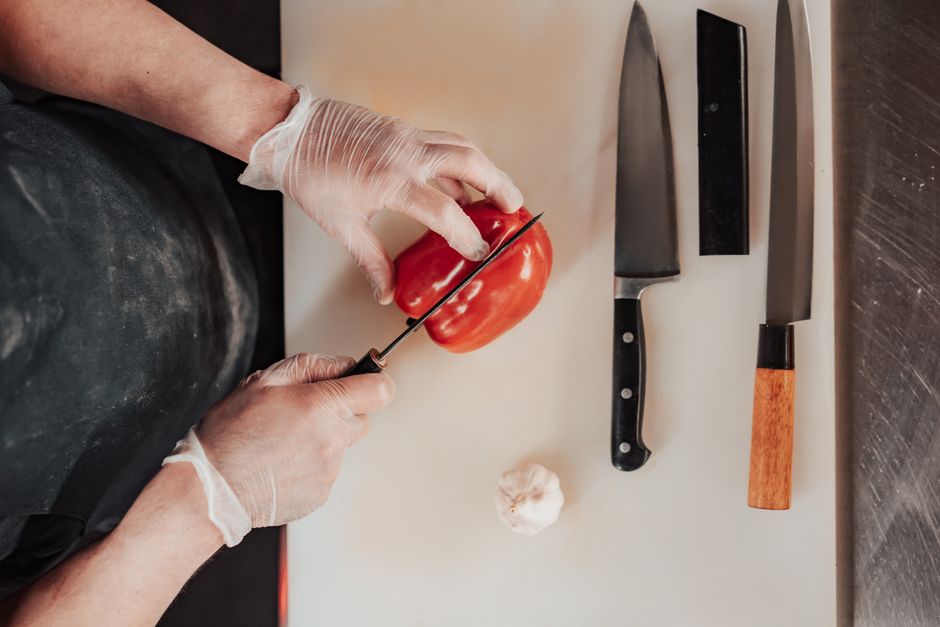
- The 8-Inch Chef’s Knife: The undisputed king of the kitchen. Rock it, slice it, chop it. This tool does the heavy lifting.
- The 3.5-to-4-Inch Paring Knife: For intricate peeling, trimming, and small hand tasks where the chef’s knife is too clumsy.
- The 5-to-6-Inch Utility or Santoku Knife: A bridge between the two, perfect for slicing citrus, smaller vegetables, and sandwich prep.
If you genuinely need steak knives, buy a separate, dedicated set of four plain-edge steak knives later. Never buy a bundled set where half the pieces are cheap serrated steak knives that tear meat rather than slicing it cleanly.
Handle Ergonomics and Balance: The Feel Test
You can buy the best steel in the world, but if the handle gives you blisters or feels like a slippery bar of soap when your hands are wet with chicken juice, it’s useless.
When evaluating handles on a moderate budget, look for full-tang construction secured with visible rivets or seamless molded composite materials like POM (polyoxymethylene) or Pakkawood. Avoid cheap hollow plastic handles that trap water and harbor bacteria—a sanitary concern regulated by health agencies like the Food and Drug Administration when evaluating commercial environments.
Balance matters, too. Hold the knife where the blade meets the handle (the pinch grip). The knife should feel like a natural extension of your arm, neither too blade-heavy nor handle-heavy.
Frequently Asked Questions
Should I put my new kitchen knife set in the dishwasher?
Never. Absolutely not. Dishwasher detergents are highly abrasive, the high heat warps wooden and composite handles, and the violent tumbling knocks your blade edges against other utensils, dulling them instantly. Wash them by hand immediately after use and dry them with a towel.
Are Japanese or German knives better for a moderate budget?
It depends on your cutting style. German knives (like Victorinox or Wüsthof’s budget lines) use softer, tougher steel with a wider bevel angle (20 degrees), making them resilient against bone and heavy twisting. Japanese knives (like Mac or Tojiro) use harder steel with a steeper angle (15 degrees) for ultra-precise, razor-thin slices, but they can chip if abused. For general home cooking on a budget, versatile German-style or hybrid stainless steels are usually more forgiving.
How often do I need to sharpen a budget knife?
Frequency depends on usage, but you should run your chef’s knife over a ceramic honing rod every 3 to 5 cooking sessions to realign the microscopic teeth of the edge. Actual sharpening on a whetstone or with a quality guided sharpener only needs to happen once or twice a year if you take care of your blades.
Is it better to buy knives individually or as a set?
On a moderate budget, buying a curated 3-piece starter set or purchasing individual core knives (Chef’s knife + Paring knife) almost always yields higher quality. Pre-packaged large sets force you to pay for filler items you will never use.